Bird Pest Control Experts Since 1964.
[ Home ] :: [ Products ] :: [ References ] :: [ Contact Us ]
[ Sonic Repellers ] [ Roost Inhibitors ] [ Taste Aversions ] [ Animal Repellers ][ Accessories ]
Reprinted with permission:
RH : Recorded Alarm calls for goose dispersal
Efficacy of Recorded Alarm and Alert Calls for Canada Goose Dispersal
LUKE A. STRENG , Marysville OH 43040, USA
PHILIP C. WHITFORD, Capital University Biology Department, Columbus, OH 43209, USA
Abstract: Effectiveness of replay of alarm and alert calls at dispersing giant Canada geese, Branta canadensis maxima, was tested on 10.0 hectares of grass seed and herbicide treatment test growth plots which experienced daily usage by 2-400 resident geese/goslings. Tests 5 June- 25 July 2001 used 2 modified Bird X-Peller systems provided by Bird-X Inc, 300 N. Elizabeth, Chicago IL 60607, which played naturally recorded alarm and alert calls of the species daily at randomized 5-10 minute intervals dawn to dusk. Geese were flightless via molt of primaries, and many goslings (< 3 weeks of age) were present when call playback was initiated. Initial response to call playback was complete absence of geese from 15-16 hec for 4 days. Geese could not escape the playback, and habituation appeared after roughly 1350 call repetitions compressed over 5-7 days. Geese continued to avoid the most exposed test plots at significant levels three weeks after the call units were turned off. Initial response suggests these units should show efficacy at dispersing flighted geese at sites where they can readily escape the audible range of the Bird-X-Pellers.
INTRODUCTION
The Giant Canada Goose, Branta canadensis maxima, population has skyrocketed in the past 20 years. Once thought extinct, they have rapidly repopulated much of their historic range and expanded into new areas via translocation programs of the 1970’s and 1980’s, becoming a nuisance in many areas of the United States, Canada and New Zealand. Giant Canada geese are commonly found in areas having mowed grass associated with a body of water, thus providing both foraging sites and safety (Conover 1991). Given a feeding preference for short, highly fertilized grass of high nutritional content it is clear why giant Canada geese have infiltrated suburban and city environs with their many lakes and ponds, business parks, golf courses, parks and homes all of which fertilize and mow heavily for aesthetic reasons.
Homeowners, corporations, golf courses and farmers have sought ways to deter geese from inhabiting their property. Golf courses have used Border Collies, firecrackers, guns (blanks), decoys, balloons, wires, and general harassment (Conover 1991). Farmers have tried propane exploders, scare flags, shell crackers, and hunters, all of which have proven unsuccessful at keeping geese from crops in the long term (Conover 1991). Rapid habituation to lasers used for dispersal on confined geese was recently reported (Blackwell, et al 2002). Tests of early audio systems in agricultural fields deterred geese in some areas, while no effect was seen in others, and geese habituated to propane exploders as well (Conover 1991). Reports indicate repeated presentation of taped distress calls to geese led to decline in response (Aubin 1990) or failure to respond (Aquilera 1991), and goose return once playback terminated (Mott and Timbrook 1988).
Geese have species-specific alert and alarm calls. Alert calls warn of danger at a distance (Boudreau 1968). Giant Canada goose alert calls, phonetically “Hrr-urr-uh,” used call forms H and I, in frequency ranges from 450cps, base frequency, to 1450 cps for 1st harmonics and 0.3 - 0.64 sec in duration varying with sex, age, and intensity of the alert reaction (Whitford 1987). Alert calls may reflect two levels of intensity: mild apprehension, with no need for immediate response, at intervals of >5 sec between successive calls; and, a more imperative warning of perceived impending danger < 0.3 sec between multiple calls commonly leading to “orderly mass movement” of geese from the area (Whitford 1987, 1998). Low intensity alert calls cause nearby geese to raise their heads, extend the neck vertically and look in the direction the caller faces, “an alert posture,” as it is described by Balham (1954) and modified by Klopman (1958). If danger is not imminent, and calls cease, geese often resume eating (Whitford 1987).
“Alarm calls,” one of the least used calls of the species, are comprised of a mixed series of call forms. All Canada geese present normally take flight, if possible, or seek the relative safety of water when alarm calls are given (Whitford 1987). Alarm calls used 0.20 0.23 sec duration “A” calls at 0.55 sec intervals mixed with “J” calls of 0.37 sec duration and 0.42 sec intervals for males, and female “E” calls of 0.1 - 0.13 sec duration and undeterminable interval in the only series sonographed (Whitford 1987).
Most avian species have auditory discrimination ability to as little as 20 Hz at 2 kHz (Dooling 1982). While alarm and alert calls are given at frequency ranges preferentially responded to by their own species, auditory discrimination may permit geese to identify specific calls as being from one individual, or recorded source. Thus, they may learn to ignore it (habituate) or respond to it based on past experience, using call form, frequency, duration and interval as discrimination parameters and dominance status of callers (Whitford 1987).
This study was designed to test efficacy of Canada goose alert and alarm calls described above for goose dispersal using a timer controlled, microchip-based audio system for playback. We focused on defining: 1) how discriminating and long lasting was the memory of Giant Canada geese for specific alert and alarm calls; 2) how quickly habituation occurred to repeated exposure of free ranging flightless geese to call playback while in preferred environments and unable to leave the audible range of the playback units due to gosling brooding requirements; and, 3) how long habituation lasts if the call source is removed and reintroduced at a later time.
STUDY AREA AND METHODS
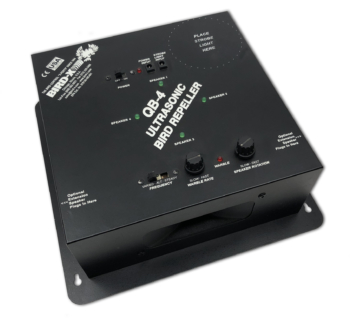
Alarm and alert calls were played back using two “Super Bird X-Peller” audio systems (Super Bird X-Pellers supplied by Bird-X, Inc., of Chicago, IL., and specially modified to playback 12 sec sequences of random alarm and/or alert calls recorded on microchips within the unit.) Calls were played by both units at 5-10 minute intervals using random time functions built into the units and with call playback from dawn to dusk by use photovoltaic control cells. Giant Canada Goose alarm and alert calls used were recorded under natural conditions by the author.
To test habituation response in the field we sought isolated, preferred giant Canada goose habitat, with ponds, well-fertilized grass, and minimal disturbance. The area found was a corporate site of 300+ hec, but we must honor the request of the sponsoring company in that we not disclose their name and precise location. Located in Central Ohio, the site had three ponds of .2 - .5 hec adjacent to 10.0 hec of grass test growth plots comprised of varied species which were heavily fertilized and cut weekly to the short length that geese prefer. The remainder of the property was lawns with widely scattered trees kept in park-like condition around the office complexes. Protected from hunting and disturbance, geese had resided there for 20 years with little fear of humans. While tolerant of the geese, the corporation that owned the site found they confused research by continually eating grasses of test growth plots, adding their own ”special brand” of fertilizer, and altering species composition of test plots via selective feeding activities. We hoped to reduce some of these negative effects by using alarm call playback to deter geese from feeding on the test plots.
Primary test areas consisted of three 3.3 hec test growth plots each seeded with different species of grasses; bent grass (Poacene agrostis); Kentucky bluegrass (Poa pretensis); and a ryegrass (Lolium sp)/crab grass (Digitaria sp) mixture. Test plots formed adjacent rectangles in an east west line with a 0.4 hec pond 50 meters to the west of the bent grass plot and a 0.2 hec pond and adjoining practice putting green (much loved by geese for feeding) some 40 m south of the central bluegrass plot. From late March to early June, before playback began, background data on time of use and goose numbers on each plot was gathered using 2 hour split block format from 06:00 to 18:00 EST. Each block was sampled once per week during this period and weather data, temperature and rough categories of cloud cover (clear, partially cloudy, overcast) and wind strength (calm, moderate, strong) were recorded to permit evaluation whether they influenced goose use of test plots. Goose numbers/plot were counted every five minutes. Sums of all geese present per hour were recorded. Background data collection continued until 1 week after all known nests had hatched. It provided baseline data and insight into feeding, resting and daily post-nesting/brooding movement of geese on this site.
Post-nesting timing of this experiment was intentionally chosen knowing the adult geese studied would have molted their flight feathers and thus could not fly, and that there was little or no suitable brooding habitat for the goslings away from the corporate property. This meant the geese had to remain within audible distance of the Bird-X audio alarm/alert call systems. In this manner, we could determine learning, memory and habitation rates to continual playback conditions using free ranging geese.
On 5 June, as goose numbers on the plots stabilized following nesting, two “Bird X-Peller” prototype audio systems were placed roughly 300 m apart; one at the southeast corner of the central bluegrass plot, the other at the northcentral section of the western bent grass plot. Before the units were activated, they were left in place for 10 days, and data collection continued to assure that goose response was to call playback and not a reaction to presence of the speakers and post-mounted units.
The call systems were activated about 10:00 hours June 14th. Geese were observed for the next two weeks to evaluate plot usage by geese with alarm/alert calls playing at 5-10 minute intervals dawn to dusk. During the first week following system activation goose counts were made hourly for all time blocks to assist in determining when they first reappeared on the test plots. First day data was supplemented by description of behavioral responses and actions of geese during the first hours of playback. After two weeks the units were turned off and remained off for three weeks to allow geese an opportunity to recover from constant call playback. The units were then moved to alter the directional source of the sound, turned on and the reaction of the geese was recorded again. Observations continued until evidence of habituation reappeared. Goose movement away from plots or absence during normal use hours was considered indication of efficacy of alarm and alert calls in dispersing geese from test plots. Goose presence upon the plots while calls were still being played was considered evidence that habituation to the calls had occurred.
One-way ANOVA was used to determine whether significant changes in geese counted/hour/plot occurred with call playback in three designated phases of the study: 1- pretest phase (before call unit use); 2- playback phase; 3- post-habituation playback phase. One-way ANOVA was also used with goose counts on the various test plots to determine grass preferences, changes in weekly usage and daily hours of goose usage of plots across the study phases, and at various mean temperatures, cloud cover and wind strength per observation block.
RESULTS
Activation of the first X-Peller unit on June 14 was done while 125-130 adult geese and 1-3 week old goslings were present on or adjacent to the bent grass plot near the large western pond (within 150 m of call unit). Another 150-155 adult geese and goslings were present on the putting green and lawn 40-60 m south of the bluegrass test plot. At the first call playback of the western unit all geese and goslings within 150 m of the unit immediately began running toward the pond. When calls stopped 12 seconds later they gradually slowed to a walk with heads fully erect in alert posture and continued toward the pond while looking about. They had just begun to relax 7 minutes later when the unit played again and once more sent them running for water. Geese 300 m away at the putting green, especially adults with goslings, raised their heads at each call of the distant unit and stayed in alert postures, moving nervously, grouping goslings together.
The second call unit, located about 125 m northeast of the putting green (300 m from the first) was activated twenty minutes after the first unit’s playback began. At this additional stimulus, geese and goslings near the putting green all first walked quickly into the pond and milled about in alert postures. After two more sets of call playback from both units the geese exited the water and walked away across open lawn to points >.3 Km from the units. Addition of a second call unit’s alarm call playback distant from the first appeared to increase overall agitation of geese and stimulated them to leave the area. Within minutes of the second unit’s call playback there were no geese to be seen on the test plots, ponds, or lawns of the adjacent corporate grounds, leaving more than 35 hec completely cleared of geese. Those areas remained completely clear of geese for 4 days after call units were activated. The large area cleared indicates the X-Pellers worked over a much greater range than the 7 acres/unit the manufacturer had claimed in literature accompanying them.
First signs of habituation appeared late on the fifth day as a few geese began returning to test plots to feed. Within 2 more days most remaining geese returned to the test plots, apparently drawn by the sight of the other geese feeding there, though statistically significant reduced use of test plot areas distant from the safety of water remained evident. By the 8th or 9th day, unless they were near the X-Pellers, most geese did little more than raise their heads to alert postures when alarm call playback occurred. Reactivation of X-Peller playback in the 8th week caused geese to temporarily resume alert postures, but did not lead geese to leave the area.
Results of goose numbers observed on the test plots are divided into three phases representing pre-sound system activation (phase 1) data; sound system activated (phase 2) data; and post habituation tests after a three-week break from call playback (phase 3). One-way ANOVA of average numbers of geese observed/hour on each plot across the three phases of the study and indicated: significantly fewer geese in phases 2 and 3 than in phase 1 on both the blue grass and mixed grass plots, F (2,77) = 8.37, p<.05 and F (2,77) = 3.95, p<.05, respectively; and, no significant difference across phases for the Bent grass plot, F (2,77) =.2, N.S.
The Canada geese studied significantly preferred the bent grass test plot over the other two grass forms, F (2, 237)= 15.25, p< .05, as indicated by higher numbers of geese observed there during all observation periods. Average numbers of geese observed on each plot for all phases/observations were 215.3, 48.3, and 24.6 for the bent grass, bluegrass and mixed plot, respectively. Weekly goose numbers on each plot are reflected in Table 2. Weeks 1-3 represent pre-call system use samples; weeks 4 and 5 represent weeks of X-Peller/call use; and, week 8 was when the units were reactivated after being shut off for three weeks. The data corresponds to number of geese observed per plot with all observation periods per block being summed for the week. ANOVA’s indicated that there was no significant change for the bent grass, F (5, 74) = 1.92, N.S. and significant changes for the bluegrass and mixed plot, F (5,74) = 7.04, p<.05 and F (5, 74) = 5.74, p<.05, respectively. A separate analysis of the bent grass plot for week four alone would make the reduction in goose numbers for the week following unit activation much more obvious since the numbers dropped to zero for five days of that week.
Table 1- Average number of geese counted on test plots per hour in each phase
Phase 1 Phase 2 Phase 3 Bent grass Plot 241.7 202.9 168.3 Bluegrass Plot 89.49 4.6 24 Mixed Plot 51.82 0 0
Table 2- Average number of geese on the plots for the data collection weeks of study
Pre-call playback periods Post call playback periods
Weeks1 2 3 4* 5 8 Bent grass Plot 9.7 393.1 255.9 73.3 332.5 168.3 Bluegrass Plot 18.8 79.9 149.3 3.6 5.6 24 Mixed Plot 8.2 13.4 121.4 0 0 0 *First week of alarm/alert call playback
Preferred goose use times for grass test plots based on one hour data collection
system are reflected in Figure 1. No significant differences in goose numbers/time were found for any grass type, but a trend was evident for greater numbers on the bent grass between 11:00 and 13:00 hours.
Figure 1. Daily Patterns of Test Plot Use Prior to Call Playback.
![]()
When goose use of the test plots was correlated with wind strength and with cloud cover difference was not significant for the heavily used bent grass plots. Significant differences existed for both conditions for the bluegrass and mixed grass plots as wind speed increased, F (2, 77) = 8.89, p<.05, F(2,77)=3.01, p<.005 and as cloud cover increased F(2, 77) = 7.17, p<.05 and F(22, 77) = 3.70, p<.05, indicating geese were more likely to use open test plots as wind speed and cloud cover increased.
ANOVA of temperature and number of geese observed on each grass test plot indicated there was a significant inverse relationship between temperature and the number of geese on the bluegrass plot: r (78) = -.384, p<.05, and for the mixed grass plot r (78) = -.368, p<.05., but not for the bent grass.
DISCUSSION
Tests comparing goose use of the grass plots from weeks 1-3 (phase 1) and weeks 4 and 5 (phase 2) showed that the sound system did in fact discourage geese from feeding on the plot. During pre-call playback versus playback phases of the study, the goose numbers dropped significantly on the bluegrass, declining from 149.3 to 3.6 per hour on the bluegrass, as well as from 121.4 to 0 per hour for the mixed plot. The bent grass also showed a decrease (255.9 to 73.3) in mean numbers of geese feeding during the observed hours with the latter figure reflecting geese returning at the end of the first week of call playback, as well as absence of geese during the first five days of X-Peller use. The decrease in geese on the bent grass plot would be significant if only goose numbers from days 1-5 after implementation were to be used. Still these figures don’t adequately show what the initial reaction was when the alarm/alert calls were first played.
Soon after call playback was initiated by both call units, the entire goose population fled from the area in alert postures. They couldn’t take flight because they had molted their flight feathers, so they walked off keeping the goslings close beside. In fact, beginning by the time the calls had been repeated 4-5 times by each call unit, roughly 30 minutes after the first call was played, not a single goose was seen near test plot areas for four full days. On the fifth day after X-Peller activation, two geese entered the Bent Grass plot. Thereafter more geese moved on to the Bent Grass plot to feed over the course of several days and habituation was soon complete, so goose numbers rose quickly in week 5. Goose numbers remained significantly below phase 1 numbers on the Bluegrass and mixed grass plots even into the 5th week, probably indicating that geese were reluctant to feed that far from the water while the call units were functioning even once habituation had begun.
While the data indicate that the geese habituated rather quickly to the call playback, it doesn’t mean the use of recorded alarm calls would be ineffectual in other circumstances. By using flightless geese with goslings confined to a test area where they could not escape from the continual 5-10 minute cycle of playback of the alarm and alert calls by both units, played from dawn to dusk daily, the study was able to define the maximum rate at which habituation could occur. Since both goslings and adults needed high quality feed to support their rapid growth and feather replacement respectively, and that feed was only available on the test plots and putting green, geese had little option but to approach the call units and learn to ignore them to gain food for themselves and their young. If one considers the number of call playbacks heard per goose over five days, at one call playback per 7.5 minutes, on average, for each of two call units (18 alarm calls per hour) 15 hours per day, that amounts to roughly 1080 calls over four days, or 1350 calls over the 5 days before wholesale habituation began to occur.
Geese which had the option of flying away to someplace out of hearing range of the call units when they first broadcast alarm calls might well be expected to delay habituation for months or longer if that many calls must be heard before they cease to respond to them. As long as there are alternate areas that the geese might use to meet daily needs, and which are out of hearing range of the call units, they might well never return to the original site where call units were in use.
Prior tests using playback of alarm calls recorded under conditions which make them more likely to actually be true alarm calls rather than the “distress calls” distributed by Cornell University as alarm calls, reported that the calls were effective on flighted geese at Tennessee campgrounds and continued to disperse geese for the full 6 weeks of testing (Mott and Timbrook 1988). Further tests of our recordings in field settings when all geese have flight feathers to facilitate rapid escape from the playback area are planned to define rates of habituation under those circumstances.
Rapid habituation in confined geese gives evidence of how quickly the giant Canada goose may learn to recognize a specific call and to what limits it will perceive a given call as being the same call when played repeatedly without additional stimulus. The call used in this study was a single repeated copy of an alarm call with no alteration in frequency or duration parameters. We are currently modifying the call digitally to provide variation in frequency and duration of call components, which should make it much more difficult for geese to recognize and define as being from a single individual, since these parameters are thought to form the basis for individual recognition of calls in both individual and duetted call series of the species (Whitford 1996). This modification may in turn increase efficacy and assist in delaying habituation in future tests of the alarm call playback system.
Prior to this test it was not known whether this call’s playback would initiate fixed action patterns of escape behavior within the geese or how long it would require for them to discriminate and habituate to a taped alarm call. The study has effectively answered how long habituation requires under continuous daily exposure to a single copy of the alarm call. Call playback in week 8 evidenced little response other than birds assuming alert postures and grouping together. There was some movement away from the call sources, but not the mass egress seen in the first use. Thus, the geese remembered the call and retained the habituation response to it at least three weeks after if first developed..
Observed preference for various grasses by the geese were largely expected based on prior observation of feeding activity at the test site. There was a strong preference for the Bent Grass, followed by the Blue Grass and last the mixed grasses. Yet, this may have been influenced strongly by the presence of the large pond and the safety water represents to flightless geese. The pond was nearest to the Bent Grass, with the smaller pond being near the Blue Grass, and the mixed grass plot farthest removed from any water. Preference for palatability of Bent Grass may explain why the geese, after the alarm call playback began, rapidly returned to eat the Bent Grass. Or, it may be that proximity to the larger body of water, and therefore safety, caused geese to feed preferentially on the Bent Grass plot as they habituated to the calls. Since all grass test plots were kept short, highly fertilized and thus highly nutritious, grass species should be assumed the basis for selection preference, if water proximity is ignored. Geese select grass that is easier to digest and yields more calories/gr and selection of bent grass may reflect this preference (Conover 1991).
The peak time-periods of goose use of food plots showed that all three plots evidenced higher goose numbers during the 11a.m. to 1 p.m. time period. This may reflect preferred feeding times of the species, or more probably may reflect that landscaping crews were on lunch break so mowing and other lawn maintaining activities were at a daily minimum during these times. In prior study of the species feeding tended to be episodic with heaviest feeding during early to mid-morning, and again during midday and mid-afternoon time periods (Whitford 1987).
Data indicate that strong breezes didn’t deter geese from feeding and may have actually led to an increased use of the mixed grass plot. Additionally, goose numbers were observed to increase as cloud cover increased. Both increased wind strength and cloud cover would help reduce heat absorption and keep birds cool while feeding in open areas of test plots otherwise exposed to full sun. On warm sunny days geese tend to seek shade during warmest hours and feed in the open more in morning and afternoons (Whitford 1987). That theory is supported by results of temperature/feeding correlation tests which indicated that a decrease in temperature corresponded to an increase in geese on the bluegrass and mixed grass plots. In any case, neither wind, temperature, or cloud cover appeared to play a significant role in how the geese responded to alarm call playback.
An important aspect to remember about this study is that the geese were flightless and accompanied by young goslings with no suitable brood rearing habitat near the study site, other than the grass test plots. This is a major factor in understanding that the geese could not get out of hearing range of the calls and meet food needs of the goslings, adult females which had not fed for four weeks while incubating nests, and molting adults all in need of extensive feeding to gain/regain lost weight and provide protein for feather growth. This is an important consideration because it implies that alarm call use when the geese can leave the audible range should greatly delay habituation response. Thus, the calls may prove useful for long term removal of geese from areas they are not wanted if used solely on flighted geese.
MANANGEMENT IMPLICATIONS
Data collection in the three phases permitted before-and-after comparison of goose use of the three plots with call playback and without. The first playback phase evidenced clear response to alert and alarm calls, and defined for a single specific call what constitutes a maximum habituation rate under continual call playback condition. The third phase showed there was no significant change from the second week of phase 2, meaning geese recalled the call playback as non-threatening.
The implications of these tests provide some hope that companies, farmers and communities that wished to remove geese from their lands may benefit from proper limited use of call units broadcasting alarm and alert calls. Clearly, there is evidence for giant Canada geese of memory of calls that have been habituated to in the recent past. By finding that geese can habituate within five to seven days and that they can remember to ignore that call, we are one step closer to defining applications and limitations of audio playback of Alarm and alert calls for goose dispersal. Results imply that alarm calls have greatest chance of long term success during fall and winter months when geese are mobile and less likely to experience repeated exposure to call playback. The next step in research will be to try a similar test with a mobile flock unexposed to the call playback and able to escape the playback area entirely to see if they also habituate, and how long it takes under such circumstances. Such tests are being completed at present and results should be available by mid-summer of 2002.
LITERATURE CITED
Aquilera, E. 1991. An evaluation of two hazing methods for urban Canada geese.
Wildl. Soc. Bull. 19(1)
Aubin, T. 1990. Synthetic bird calls and their application to scaring methods. Laboratoire d’ Experimentale. CNRS URA, f-28210.
Balham, R. W. 1954. The behavior of Canada geese (Branta canadensis) in Manitoba. Ph.D. Thesis, Univ. Mo., Columbia. 229 pp
Blackwell, B. F., G. E. Bernhardt, and R. A. Dolbeer, 2002. Lasers as nonlethal avian repellents. J. Wildl. Manage. 66(1):250-258.
Boudreau, G. 1968. Alarm sounds and responses of birds and their application to controlling problem species. Living Bird. Vol 7: 27-46.
Conover, M. 1991. Characteristics of feeding sites used by urban-suburban flocks of Canada geese in Connecticut. Wildl. Soc. Bull. 19(1) 36-38.
Cooper, J. 1997. Urban Canada goose management: policies and procedures. Trans. 62nd Am. Wildl. And Nat. Resources Conf.
Craven, S. 1990. Evaluation of three damage abatement techniques for Canada geese. Wildl. Soc. Bull. 18(4) 405-410.
Dooling, R. J. 1982. Auditory Perception in Birds. In: Acoustic Communication in Birds, Vol. 1: Production, perception and design features of sounds. D. E.Kroodsma and E. H. Miller, eds. Academic Press, N. Y. pp. 95-130.Klopman, R. B. 1958. The nesting of the Canada goose at Dog Lake, Manitoba. Wilson Bull. 70(2) 168-183.
Martin, F. 1964. Behavior and survival of Canada geese in Utah. Job compl. Rep. For Fed. Aid Proj. W-29-R17, Job G-1. Utah Dept. of Fish and game. 89pp.
Mott, D. F. and S. K. Timbrook. 1988. Alleviating nuisance Canada goose problems with acoustical stimuli. Proc. Vertebr. Pest Conf.(A. C. Crabb and R. E. Marsh, Eds), 13: 301-305. Whitford, P. C. 1987. Vocal and visual communication and other social behavior of Giant Canada geese, Branta canadensis maxima. Dissertation. Univ. of Wis.- Milwaukee. 430 pp.Whitford, P. C. 1996. Temporal alteration and coordination of calls by paired Canada geese in duetted calling of aggression, territorial, and triumph behavior.The Passenger Pigeon Vol. 58 (3) 249-258.Whitford, P. C. 1998. Vocal communication of Giant Canada geese. In: Biology and management of Canada geese. Pages 375-386 in D. H. Rusch, D. D.Humburg, and B. D. Sullivan, eds. Biology and management of Canada geese. Proceedings of the international Canada goose symposium. Milwaukee Wis.